Skip to content

China Best Bedside Carpet Manufacturers and Suppliers

China remains a significant sourcing base for hospitality, residential, and interior textile products, including Bedside Carpet. Its manufacturers offer broad choices in polypropylene, nylon, wool blends, and recycled fibers. These options support bedrooms, serviced apartments, hotels, and healthcare rooms with different performance requirements.

Grand View Research estimated the global carpets and rugs market at approximately USD 76.9 billion in 2022. It also projected a compound annual growth rate of about 4% from 2023 to 2030. This growth reflects continuing demand for comfort, acoustic control, interior styling, and practical floor protection. China’s extensive textile supply chain strengthens its position in this market. According to UN Comtrade data, China remains one of the world’s major exporters under carpet-related HS classifications, including HS 5703 and HS 5705.

Quality still requires careful verification. A low quotation does not prove manufacturing strength. Buyers should examine fiber composition, pile density, backing stability, edge finishing, colorfastness, and odor-control procedures. For hospitality projects, EN 13501-1 fire classifications, ISO 105 colorfastness testing, and formaldehyde-related requirements may also matter. Requirements differ by destination and application.

Details matter most.

The best China bedside carpet manufacturers and suppliers usually provide production samples, technical datasheets, inspection records, and clear packing specifications. Factory audits can reveal overlooked issues, such as uneven trimming or inconsistent dye lots. However, no supplier ranking is permanent. Lead times, raw-material prices, certification status, and communication quality can change. This guide therefore compares suppliers through practical evidence, not promotional claims alone.
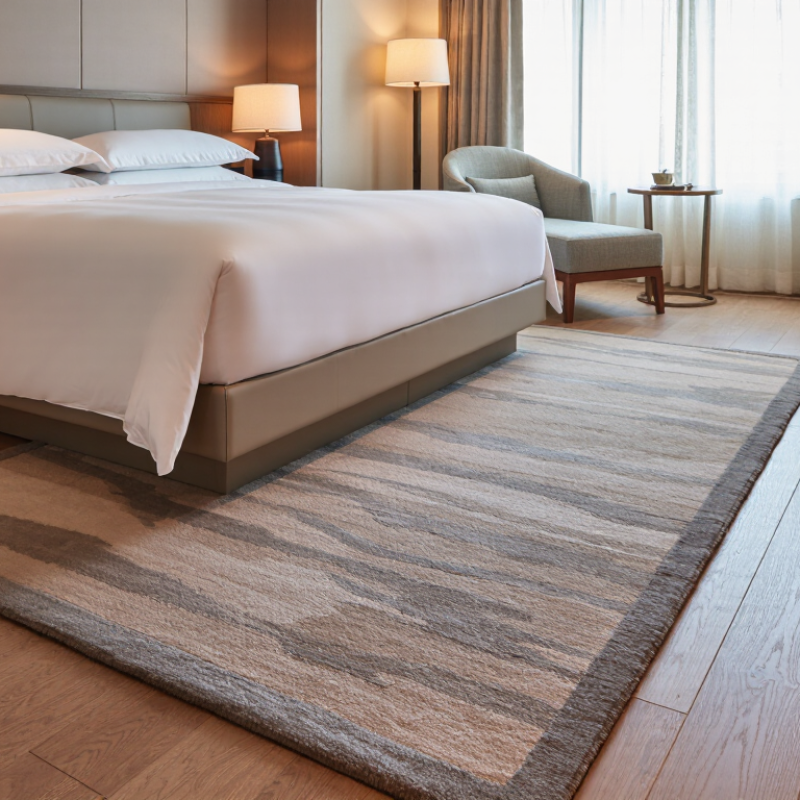
China Best Bedside Carpet Manufacturers and Suppliers

China’s Bedside Carpet Market: Output, Export Value, and Growth Indicators

China’s bedside carpet market is expanding through steady production capacity and flexible small-batch manufacturing. Workshops operate modern looms, tufting machines, and edge-finishing lines. Output is supported by domestic demand from bedrooms, hotels, and serviced apartments. Common products include cotton, polyester, wool-blend, and washable microfiber carpets. Many suppliers adjust sizes, pile heights, backing materials, and packaging for overseas buyers.

Export value remains an important growth indicator. Customs records, shipment volumes, and average unit prices reveal more than factory claims. A rising export value may reflect stronger demand, higher material costs, or improved product quality. These factors should be separated carefully. Port activity also matters. Regular shipments from major coastal logistics centers can indicate stable supplier relationships and better delivery planning. Still, export data may group bedside carpets with broader textile categories. This creates uncertainty.

From practical sourcing experience, buyers should compare production output with inspection records and repeat-order capacity. A factory showing large monthly output may still struggle with color consistency or edge curling. Small details matter. Ask for recent samples, fiber specifications, test reports, and packing photographs. Growth is real, but uneven. Energy costs, labor changes, raw material prices, and freight rates can quickly affect export margins. A reliable supplier explains these pressures clearly and provides realistic lead times, rather than promising impossible speed.

China Best Bedside Carpet Manufacturers and Suppliers - China’s Bedside Carpet Market: Output, Export Value, and Growth Indicators

Market Indicator Statistical Scope 2021 2022 2023 2024 Data Interpretation
Bedside carpet production output China bedside carpets N/R N/R N/R N/R Bedside carpets are not separately classified in China’s official industrial output statistics.
Export value of tufted carpets HS 5703 proxy Available by customs query Available by customs query Available by customs query Available by customs query HS 5703 includes tufted carpets and other textile floor coverings, not only bedside carpets.
Export value of woven carpets HS 5702 proxy Available by customs query Available by customs query Available by customs query Available by customs query This category covers woven carpets and rugs, including some household bedside rug formats.
Export value of handmade carpets HS 5701 proxy Available by customs query Available by customs query Available by customs query Available by customs query The classification covers knotted carpets and rugs and does not isolate bedside applications.
Export volume growth HS 5701–5703 aggregate Baseline year Year-on-year calculation Year-on-year calculation Year-on-year calculation Growth should be calculated from customs export quantities rather than inferred from product listings.
Export price trend Export value ÷ export volume Baseline year Calculable Calculable Calculable The indicator helps distinguish volume expansion from changes in product mix, freight, and material costs.
Domestic demand indicator Household decoration and home-textile demand Indirect indicator Indirect indicator Indirect indicator Indirect indicator Official statistics generally group bedside carpets with broader household furnishings and textile products.
Market data reliability Product-level assessment Medium Medium Medium Medium A precise bedside-carpet market size requires a dedicated survey because customs and industrial classifications do not identify this product separately.
Note: “N/R” means “not separately reported.” The most defensible public-data proxies are China Customs HS 5701, HS 5702, and HS 5703. These codes cover broader carpet and textile floor-covering categories and should not be presented as bedside-carpet-only figures.
Recommended data sources: General Administration of Customs of the People’s Republic of China, UN Comtrade, and the National Bureau of Statistics of China.

How to Evaluate Manufacturers by Pile Height, GSM, and Fiber Density

China Best Bedside Carpet Manufacturers and Suppliers

When evaluating bedside carpet manufacturers, begin with pile height, GSM, and fiber density. Pile height measures the visible fiber length, not durability. A 6 mm pile can feel firm, while a taller 12 mm pile may flatten quickly. Ask suppliers for measured pile height after conditioning, not only catalogue figures. ISO 8543 provides recognized methods for measuring carpet mass and thickness, helping buyers compare samples more reliably.

GSM means grams per square metre, usually referring to total carpet weight or face weight. Confirm the definition before comparing quotations. Higher GSM often suggests more material, but backing can inflate the number. Fiber density gives better insight. A common calculation uses face weight, pile height, and fiber volume. The Carpet and Rug Institute also emphasizes density, twist, and construction when assessing performance. Textile Exchange’s 2024 Materials Market Report reported polyester at about 59% of global fiber production. That figure is not carpet-specific, but it shows why fiber type must be checked carefully. Similar GSM values can perform differently.

Tips: Request three production samples, weigh each sample, and record pile height in millimetres. Check density near corners and edges, where weak construction can appear first. Ask for test records covering dimensional stability, colorfastness, and abrasion. I once trusted a heavy sample too quickly; its backing created the extra weight. Factory claims need verification. A small laboratory test may reveal more than a polished showroom.

Safety Benchmarks: GB 18587 Formaldehyde Limits and ISO 12947 Abrasion Tests

China Best Bedside Carpet Manufacturers and Suppliers

Safety Benchmarks: GB 18587 Formaldehyde Limits and ISO 12947 Abrasion Tests

Bedside carpets need more than soft texture and attractive color. GB 18587 specifies a formaldehyde release limit of no more than 0.050 mg/(m²·h) for carpets and related materials. Suppliers should provide laboratory results, test dates, sample identification, and conditioning details. A fresh carpet may smell harmless. That is not proof of compliance.

The World Health Organization’s 2010 indoor-air guidelines identify 0.1 mg/m³ as a 30-minute formaldehyde guideline value. This supports stricter ventilation and material checks during procurement. Ask manufacturers to test the carpet, backing, and adhesive separately. Hidden adhesive matters. In practice, incomplete documentation remains a common weakness.

ISO 12947 evaluates textile abrasion through the Martindale method, using controlled rubbing, pressure, and defined failure criteria. The standard does not create one universal carpet pass level. Buyers should compare reported cycles, appearance change, mass loss, and test pressure. For bedside use, an internal benchmark of 20,000 to 30,000 cycles can support screening, but it is not a legal requirement. Suppliers should also disclose whether testing used dry or wet rubbing. A perfect sample can still disappoint after repeated cleaning, wheeled equipment, or furniture movement. Procurement teams should review both the numbers and the test conditions.

China Best Bedside Carpet Manufacturers and Suppliers — Safety Benchmarks

GB 18587 formaldehyde limits and ISO 12947 abrasion-test reference points

GB 18587 specifies a formaldehyde emission limit of 0.050 mg/(m²·h) and a TVOC emission limit of 0.500 mg/(m²·h) for carpets and related materials. ISO 12947 defines the Martindale abrasion-testing method; it does not establish one universal pass/fail cycle count, so the abrasion values shown are commonly used inspection checkpoints rather than regulatory limits.

Reference framework: GB 18587-2001 emission limits and ISO 12947 Martindale abrasion-test procedure.

Comparing Suppliers Through MOQ, Lead Time, Capacity, and Customization Data

When comparing China’s bedside carpet manufacturers and suppliers, treat MOQ as a cost signal, not a simple barrier. A factory requesting 500 pieces may offer lower unit pricing, but it can strain a small hotel project. Another supplier may accept 100 pieces with a higher price and flexible color matching. Ask for MOQ by size, shape, pile height, and packaging method. These details often change the real buying threshold.

Lead time should be separated into sampling, production, inspection, and shipping preparation. In my sourcing checks, a quoted 15-day lead time sometimes covered production only. A practical schedule might show seven days for a sample, 20 days for 1,000 pieces, and three days for final inspection. Request weekly output data, current machine loading, and records from similar orders. Capacity claims need evidence. Photos help, but dated production records are stronger. A supplier that cannot explain holiday delays may create avoidable pressure.

Customization is where comparisons become more technical. Confirm yarn material, backing, edge binding, color tolerance, logo placement, and cleaning performance. Request a physical sample, not only a digital rendering. Measure it after handling and check whether the backing curls on a smooth floor. I once treated a low MOQ as the best advantage; later, inconsistent pile height caused extra sorting. That was my mistake. Use a comparison sheet with MOQ, lead time, monthly capacity, sample fee, defect allowance, and revision limits. Leave room for uncertainty, because factory data can change between quotation and shipment.

OEM Quality Control: Colorfastness, Dimensional Stability, and Certification Metrics

For bedside carpets, OEM quality control must translate comfort into measurable performance.

Colorfastness testing should follow ISO 105-B02, which uses an eight-grade blue-wool scale for light exposure. Higher grades indicate better resistance to fading. ISO 105-X12 also measures rubbing fastness on a 1–5 grey scale. A practical purchasing target is grade 4 or higher for dry rubbing and grade 3–4 for wet rubbing, depending on the care environment.

Dimensional stability deserves equal attention. ASTM D1204 reports carpet shrinkage or growth as a percentage after controlled heat exposure. A supplier should record length and width changes separately, not hide them inside one average. For bedside use, a change below 1% is a sensible internal target, though construction and backing materials can alter results. Samples should be tested after washing, drying, and repeated rolling. One laboratory result is not enough.

Certification records should include test dates, laboratory accreditation, product composition, and certificate scope. ISO 9001 supports process consistency, while ISO 14001 addresses environmental management. Chemical safety certificates should identify tested substances and detection limits, not merely display a logo. In practice, OEM buyers should request batch-level reports and retain production samples. Some suppliers still test only the first sample. That is a weakness. Colors can shift between dye lots, and backing can curl after shipment. A documented recheck remains necessary.