Skip to content

How to Choose the Best Food Bucket in 2026?

Choosing the best food bucket in 2026 requires more than comparing prices and capacity. The container must protect food from moisture, pests, light, and temperature changes. It should also be easy to clean, label, carry, and inspect. USDA’s FoodKeeper guidance shows that storage time depends heavily on the food, packaging, and temperature. A strong bucket cannot correct poor storage habits.

The need is substantial. UNEP’s 2024 Food Waste Index Report estimates that 1.05 billion tonnes of food were wasted worldwide in 2022. Better storage may not solve the entire problem. It can still reduce household waste. Packaging researcher Susan Selke emphasizes that packaging should protect its contents while limiting unnecessary environmental impact. That principle matters when choosing plastic, metal, or reusable food bucket designs.

Food safety comes first. Dr. Donald W. Schaffner, a Rutgers food-safety expert, warns, “You can’t see, smell, or taste pathogens.” Select food-grade materials, secure lids, smooth interiors, and clear manufacturing information. Check whether the bucket is suitable for dry goods, liquids, freezing, or repeated use. Do not assume “airtight” means every seal performs equally. Small gaps matter. So does cleaning.

This guide examines material quality, seal design, size, durability, portability, sustainability, and value. It also questions common claims. The cheapest food bucket may cost more after damaged grains, odors, or cracked handles appear. The largest model may be inconvenient. Sometimes, a smaller bucket works better.
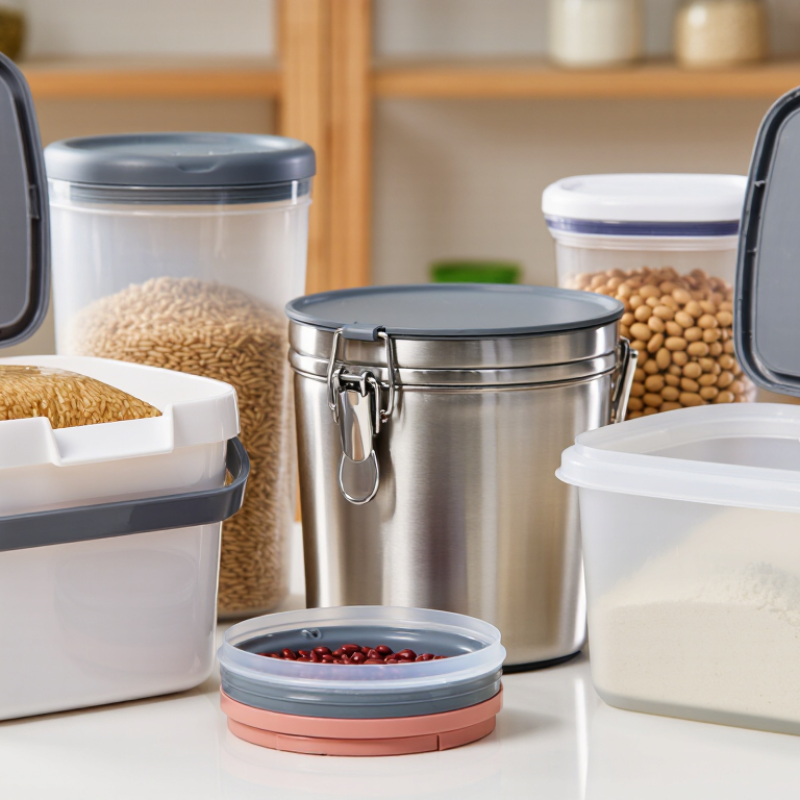
How to Choose the Best Food Bucket in 2026?

Define Food-Bucket Needs Using FEMA’s Three-Day Supply Benchmark

How to Choose the Best Food Bucket in 2026?

FEMA’s three-day supply benchmark offers a practical starting point for choosing a food bucket. Each person should have enough food and water for at least 72 hours. Food should be shelf-stable, easy to prepare, and suitable for household needs. A full-looking bucket may still provide too few calories.

Check the serving count, calories, preparation method, and expiration dates. A bucket requiring several liters of water may be difficult during a supply interruption. Choose foods that match your family’s allergies, medical needs, and eating habits. Include familiar items when possible. People often ignore comfort foods, but stress can reduce appetite. That detail matters.

Tips: Count adults, children, and pets separately. Store safe drinking water nearby. Keep a manual can opener available. Review the bucket every six months. Replace damaged packages immediately. FEMA’s benchmark is helpful, but it is not a complete plan. Three days may be insufficient for remote homes, severe weather, or delayed assistance. Add extra meals when storage space and budget allow. I would rather see a smaller supply that the household can actually eat than an impressive container left untouched.

Verify Food-Contact Safety Under FDA 21 CFR 177 Packaging Standards

How to Choose the Best Food Bucket in 2026?

Food buckets are not automatically food-safe. The resin, additives, lid liner, and manufacturing process all matter. Under FDA 21 CFR 177, compliance depends on the specific polymer and its intended conditions of use. A bucket for dry grains may not suit hot soup, oily sauces, or repeated cleaning. Check the exact regulation section, such as 21 CFR 177.1520 for olefin polymers. Ask for a supplier’s food-contact declaration and migration-test records. “FDA approved” is often too vague.

The market is large. Smithers’ The Future of Global Packaging to 2028 valued global packaging at about 1.2 trillion dollars in 2023. PlasticsEurope’s Plastics—the Fast Facts 2024 reported packaging used 39.6% of European plastics demand in 2023. More packaging means more responsibility. During purchasing audits, inspect the bucket’s inner surface, odor, color stability, and closure fit. A strong bucket should leave no chemical smell after washing. Small cracks matter.

Review test conditions carefully. FDA compliance should cover temperature, storage time, food type, and repeated contact when applicable. Request lot traceability, not only a general certificate. I would also test a sample under real warehouse conditions. Paperwork can look perfect. The container may still disappoint. Temperature cycling, stacking pressure, and rough handling deserve attention before bulk orders.

How to Choose the Best Food Bucket in 2026? - Verify Food-Contact Safety Under FDA 21 CFR 177 Packaging Standards

Food Bucket Material and FDA Food-Contact Verification Matrix
Evaluation Dimension HDPE Bucket Polypropylene Bucket PET Bucket Nylon Bucket Polystyrene Bucket
Common polymer identification High-density polyethylene; commonly identified as HDPE or recycling code 2 Polypropylene; commonly identified as PP or recycling code 5 Polyethylene terephthalate; commonly identified as PET or recycling code 1 Polyamide; commonly identified as nylon or PA Polystyrene; commonly identified as PS or recycling code 6
Potentially relevant FDA regulation 21 CFR 177.1520, Olefin polymers 21 CFR 177.1520, Olefin polymers 21 CFR 177.1630, Polyethylene phthalate polymers 21 CFR 177.1500, Nylon resins 21 CFR 177.1640, Polystyrene and rubber-modified polystyrene
Typical food applications Dry grains, flour, sugar, powdered ingredients, refrigerated foods, and general food storage Dry foods, refrigerated foods, reusable food containers, and applications requiring greater stiffness or heat resistance Clear packaging and selected food-contact containers; suitability depends strongly on design and processing Specialized food-contact components; less typical for large bulk-storage buckets Limited food-contact applications; verify carefully before use with fatty or hot foods
Temperature guidance Generally suited to cold and ambient storage; hot-fill use requires product-specific validation Often better suited than HDPE for elevated temperatures, but the exact limit must be confirmed for the finished bucket Temperature performance varies by grade, wall design, and manufacturing process; do not infer suitability from resin name alone May tolerate higher temperatures than common commodity plastics, but moisture absorption and grade selection must be evaluated Normally selected for lower-temperature applications; avoid hot-fill use unless specifically validated
Chemical and moisture resistance Good moisture barrier and broad resistance to many aqueous food ingredients Good moisture resistance and generally strong resistance to many acids, bases, and food ingredients Good clarity and moisture resistance; compatibility with concentrated chemicals and fatty foods requires validation Can absorb moisture and may be affected by selected chemicals; requires application-specific review Rigid but relatively vulnerable to solvents and some oils; application-specific compatibility testing is important
Key food-contact evidence to request Material declaration, additive and colorant information, intended-use conditions, and migration or extractives data where applicable Material declaration, resin and additive details, intended temperature and food types, and supporting compliance documentation Polymer formulation, catalyst and additive information, food-contact conditions, and relevant migration testing Nylon resin identity, additives, moisture-related limitations, and supporting extraction or migration results Polymer and modifier details, colorant information, food type, temperature, contact duration, and migration evidence
Main verification risks Non-food-grade recycled content, unsuitable pigments, unknown additives, and use outside the documented conditions Unverified fillers, colorants, processing aids, and assumptions that higher heat resistance automatically means food-contact compliance Material confusion with non-food packaging, unsuitable closures or liners, and insufficient validation for fatty foods Moisture uptake, formulation-specific migration, and limited suitability for ordinary bulk food buckets Potential brittleness, solvent sensitivity, and inadequate evidence for hot, oily, or long-duration food contact
Practical selection assessment Strong general-purpose choice when documented as food-contact compliant Strong choice where stiffness or elevated-temperature performance is important Suitable only after confirming the exact grade, design, and intended food-contact conditions Specialized option rather than a default bulk-storage bucket material Use only when the exact product has clear food-contact documentation for the intended application
Recommended purchasing check Confirm the finished bucket, lid, gasket, inks, coatings, and recycled content are all covered by the compliance statement Confirm all components and the specified temperature range, especially for reusable or hot-fill applications Confirm the intended food category, contact time, temperature, and closure system rather than relying on transparency Request application-specific testing and verify moisture conditioning requirements before purchase Require written food-contact documentation and avoid general-purpose containers with no intended-use statement
Important verification note: FDA 21 CFR references apply to specified substances, formulations, and conditions of use; they do not automatically certify every finished bucket made from a particular polymer. Verify the current eCFR requirements, the exact formulation, additives, colorants, recycled content, lid and gasket materials, food type, contact time, and temperature before making a purchasing decision.

Compare HDPE and PET Buckets by Durability, Light Protection, and Seal Design

Choosing the best food bucket in 2026 starts with the product, not the resin label. HDPE usually handles drops, stacking pressure, and cold storage well. Its naturally opaque body also blocks more light than clear PET. That matters for oils, grains, powders, and light-sensitive ingredients. PET feels stiffer and often looks cleaner. However, clear PET can expose food to ultraviolet and visible light unless pigments, sleeves, or barriers are added. The appearance may mislead.

Seal design deserves equal attention. A tight lid needs consistent rim dimensions, enough compression, and a gasket that survives repeated opening. HDPE buckets often tolerate rough handling, but a flexible wall can distort under an uneven lid. PET offers rigidity, yet brittle behavior may increase after severe impact or low-temperature storage. ASTM D4169 distribution testing can simulate vibration, drops, and stacking, but one successful test is not a lifetime guarantee.

Check the details. According to the U.S. EPA’s latest comprehensive packaging dataset, containers and packaging represented 82.2 million tons, or 28.1% of U.S. municipal solid waste in 2018. The figure is old, but it shows why reusable design and accurate material selection matter. PlasticsEurope reported that packaging represented about 40% of European plastics demand in 2022, reinforcing the scale of this decision. My practical test is simple: fill the bucket, invert it, stack it overnight, and inspect the rim, gasket, and handle. I would still hesitate before trusting laboratory data alone. Real warehouses are messier.

How to Choose the Best Food Bucket in 2026?

HDPE vs. PET Buckets: Durability, Light Protection, and Seal Design

Ratings use a typical 1–5 comparison for food-grade bucket applications. HDPE generally offers higher impact resistance and stronger protection when manufactured as an opaque container. PET provides excellent clarity and a strong oxygen barrier, but transparent PET offers limited protection from light unless UV-blocking additives or an external barrier are used. Seal performance depends mainly on the lid geometry, gasket material, and closure system rather than resin type alone.

Match Bucket Capacity to USDA Storage Guidance and Household Serving Needs

How to Choose the Best Food Bucket in 2026?

Match Bucket Capacity to USDA Storage Guidance and Household Serving Needs

Choosing a food bucket starts with servings, not bucket size. The USDA does not prescribe one universal container for every household. Instead, its FoodKeeper guidance emphasizes suitable storage conditions, expiration awareness, and food-specific handling. Use those principles when planning dry staples, grains, beans, or powdered foods.

Count how many people you feed and how many servings you use weekly. A two-person household may manage better with several small buckets than one large container. Smaller containers reduce repeated opening, moisture exposure, and forgotten leftovers. Label each bucket with the food name, packing date, and expected use-by period. Keep them in a cool, dry, dark area. Keep them off concrete floors.

Check the nutrition plan, too. USDA MyPlate guidance supports variety across grains, vegetables, fruits, proteins, and dairy or fortified alternatives. Filling every bucket with rice may look efficient, but it creates an incomplete meal plan. I once underestimated how quickly breakfast foods disappeared. That mistake changed my calculations. Measure actual household portions for two weeks, then multiply the average by your target storage period. Leave modest headspace when needed, and inspect containers regularly for insects, odors, dampness, or damaged seals. A bucket that is too large can waste food. A smaller, clearly dated bucket may serve you better.

Evaluate Shelf Life, Rotation Costs, and Total Value Before Buying

The best food bucket is not always the largest or cheapest. A bucket is a container, not a preservation method. Shelf life depends on moisture, oxygen, temperature, light, and the original food quality. The USDA FoodKeeper tool, developed with Cornell University and the FDA, shows that storage periods vary widely even among dry foods. Check the seal, liner, closure, and printed production date before purchasing. A five-year claim means little if the lid leaks in a warm garage.

Rotation costs deserve equal attention. The UNEP Food Waste Index Report 2024 estimated that 1.05 billion tonnes of food were wasted in 2022 across households, food service, and retail. Your household will produce a smaller number, but the operating problem is similar: forgotten stock becomes disposal cost. Choose bucket sizes that match actual consumption, then record purchase dates on the lid. Keep it simple. Use older containers first, inspect them quarterly, and replace damaged seals immediately.

Total value should be measured per usable serving, not per bucket. Include purchase price, delivery, storage space, monitoring time, and likely waste. A cheaper bucket can become expensive when half its contents expire unused. I prefer comparing two scenarios: a low-cost bucket rotated often and a longer-life bucket checked less frequently. Neither is automatically better. The right choice depends on household size, diet, climate, and discipline. USDA data estimates that 30–40% of the U.S. food supply is lost or wasted, so impressive shelf-life claims cannot replace realistic rotation planning. That is worth questioning.