
Top Carbon Fiber Luggage Suppliers for Global Buyers
Global buyers are paying closer attention to Carbon Fiber Luggage. The material offers a sharp balance between low weight, stiffness, and modern visual appeal. It can protect contents during airport transfers, business trips, and frequent handling. However, carbon fiber alone does not guarantee a reliable suitcase. Design quality matters.
Dr. Paolo Feraboli, a recognized composites researcher, has stated, “Carbon fiber performs best when its design matches the load it must carry.” This principle also applies to luggage. A strong shell needs suitable layering, dependable resin, reinforced corners, and carefully tested joints. Wheels, handles, zippers, and locks deserve equal attention. A beautiful shell means little when the handle shakes after several trips.
This guide examines leading Carbon Fiber Luggage suppliers for global buyers. It considers manufacturing experience, material consistency, inspection procedures, customization capacity, and after-sales support. It also looks beyond promotional claims. Some suppliers provide impressive samples but lack stable production control. Others offer low prices, yet use mixed materials without clear specifications.
That difference matters.
Buyers should request shell composition, weight data, impact-test results, warranty terms, and packaging details. Factory photographs can help, but they are not proof. Independent verification remains valuable. Even experienced purchasing teams can overlook small weaknesses in hinges or wheel mounts. I have found that supplier transparency often predicts long-term cooperation better than a polished catalog.
The market is promising, but it is not effortless. This overview helps importers, distributors, and private-label brands compare suppliers with greater confidence. It encourages practical decisions, realistic expectations, and fewer costly surprises.
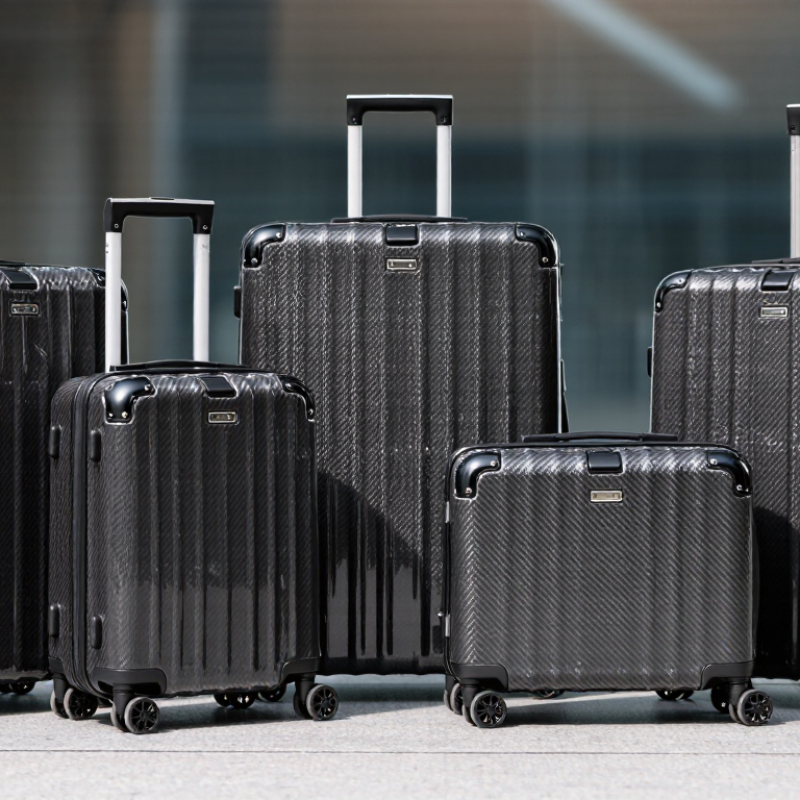
Carbon Fiber Luggage: Definition, Features, and Market Scope
Carbon Fiber Luggage: Definition, Features, and Market Scope
Carbon fiber luggage uses carbon fiber fabric within a resin-based composite shell or reinforced panel. It is not always made entirely from carbon fiber. This distinction matters when buyers compare supplier quotations. In practical sample inspections, the weave, resin finish, edges, wheels, and handle joints deserve equal attention. A glossy surface may look impressive, but it does not prove structural quality.
The main attraction is high stiffness with relatively low weight. Carbon fiber can help protect contents from bending and repeated handling. It also offers a distinctive woven appearance and strong resistance to corrosion. However, it is not magic. A sharp impact can damage a rigid composite shell, while poor edge design may cause early cracking. Repairs can also be difficult and expensive. Suppliers should provide material details, load testing results, dimensional tolerances, and clear warranty terms. Testing matters more than attractive photographs.
The market covers premium travel cases, business luggage, protective equipment cases, and customized transport solutions. Demand is growing among buyers seeking lightweight products with a technical appearance. Yet carbon fiber luggage remains costly because of material prices, skilled molding, finishing work, and quality inspection. Global buyers should assess production capacity, packaging, replacement parts, and communication reliability. A supplier with strong samples but weak after-sales support can still create problems. The market looks promising, but buyers should question exaggerated weight, strength, and durability claims.
Top Carbon Fiber Luggage Suppliers for Global Buyers - Carbon Fiber Luggage: Definition, Features, and Market Scope
| Evaluation Dimension | Verified Technical or Market Data | Implication for Global Buyers |
|---|---|---|
| Product Definition | Carbon fiber luggage normally uses a carbon-fiber-reinforced polymer shell, rather than a shell made from 100% carbon fiber. The reinforcement is embedded in a polymer resin matrix. | Confirm whether the product is a genuine composite shell, a carbon-fiber veneer, or a decorative carbon-pattern finish. |
| Carbon Fiber Density | Typical carbon-fiber density is approximately 1.75–1.95 g/cm³, depending on the fiber grade and manufacturing process. | Lower density can support lightweight construction, but the final luggage weight also depends on resin content, frame, wheels, handles, locks, and lining. |
| Mechanical Performance | Commercial carbon fibers commonly provide tensile strength of about 3–7 GPa and tensile modulus of roughly 200–700 GPa, depending on grade. | Ask for composite test data instead of relying only on fiber specifications, because shell lay-up, resin, thickness, and joint design determine actual luggage performance. |
| Weight Benchmark | A 20–22 inch hard-sided carry-on commonly weighs about 2.5–4.0 kg, while larger 24–28 inch checked cases commonly weigh about 3.5–6.0 kg. Actual values vary by construction and fittings. | Require a documented net-weight tolerance, such as ±5%, and evaluate weight together with shell thickness and hardware durability. |
| Impact Resistance | Carbon-fiber composites offer high stiffness, but stiffness does not automatically equal superior impact resistance. Impact behavior depends on fiber orientation, resin toughness, shell geometry, and edge protection. | Request drop, corner-impact, zipper, wheel, and handle-cycle tests using a defined sample size and test height. |
| Comparison with Common Shell Materials | Carbon-fiber composite generally offers higher stiffness and a premium appearance than conventional ABS or polycarbonate, while ABS and polycarbonate usually provide lower material and processing costs. | Select carbon fiber when stiffness, low weight, technical appearance, or premium positioning justifies the higher sourcing cost. |
| Surface and Finish Options | Common finishes include plain weave, twill weave, matte clear coat, gloss clear coat, textured coating, and printed decorative layers. | Specify weave pattern, resin visibility, UV-resistant coating, scratch resistance, color consistency, and allowable cosmetic defects. |
| Supplier Manufacturing Capability | Relevant capabilities include composite lay-up or molding, controlled resin curing, CNC trimming, drilling, coating, hardware assembly, and final inspection. | Prioritize suppliers that control both shell production and assembly, or require qualified subcontractor records and process-traceability documents. |
| Quality-Control Documents | Useful records include incoming-material inspection, resin and fiber batch records, first-article approval, dimensional inspection, cosmetic inspection, and shipment inspection. | Use a written inspection plan with measurable limits for weight, dimensions, shell thickness, wheel noise, handle play, and surface defects. |
| Air-Travel Size Scope | A widely used checked-baggage reference is 158 cm total linear dimensions, calculated as length + width + height. Carry-on limits vary by airline and route; 56 × 36 × 23 cm is a commonly used reference, not a universal rule. | Design and label products according to the destination airline requirements rather than treating one size as globally compliant. |
| Hardware Requirements | Key components include telescopic handles, spinner wheels, zippers or frame closures, corner guards, carry handles, and combination or approved travel locks. | Test the complete assembled case, because hardware failure is a common source of warranty claims even when the composite shell remains intact. |
| Regulatory and Chemical Compliance | Depending on the destination and product composition, buyers may need to address requirements such as EU REACH, U.S. TSCA, packaging rules, restricted substances, and labeling obligations. | Define the destination markets before production and obtain current declarations or laboratory reports for coatings, plastics, adhesives, textiles, and metal parts. |
| Market Applications | Primary applications include premium travel, executive luggage, motorsport and aerospace-inspired products, luxury gifting, corporate travel programs, and limited-production collections. | Segment the product by use case and price position instead of competing only on shell material. |
| Order and Customization Factors | Custom specifications may include shell size, weave, coating, lining, wheel configuration, handle length, packaging, and compliance labeling. Minimum order quantities vary by tooling, materials, and customization level. | Request separate quotations for tooling, samples, production units, packaging, testing, and replacement parts to make supplier offers comparable. |
| Sustainability Considerations | Carbon-fiber composites are difficult to recycle into equivalent high-performance products because fiber and resin are chemically bonded. Repairability and product life are therefore important sustainability factors. | Evaluate replaceable wheels, handles, and lining; request recycled-content claims with supporting evidence; and avoid unsupported “fully recyclable” statements. |
| Recommended Supplier Shortlist Criteria | A practical shortlist can be based on composite-process control, repeatable sample quality, documented testing, transparent material declarations, spare-parts support, production capacity, export experience, and total landed cost. | Use weighted scoring and approve suppliers only after prototype validation, factory capability review, pre-production inspection, and shipment-level quality control. |
Note: Technical ranges and travel-size references are general industry benchmarks. Final specifications should be confirmed against the supplier’s test reports, product drawings, and destination-market requirements.